

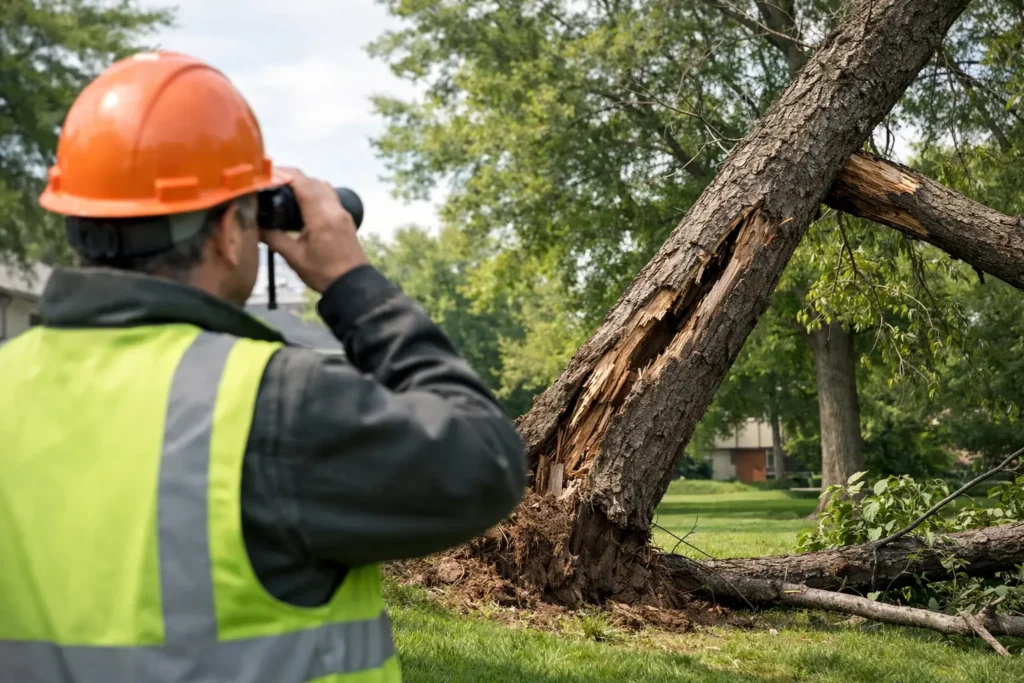
A mature tree can be one of the best features of a garden, providing shelter, privacy and character. But when its condition changes, it can also put roofs, fences, driveways, paths and neighbouring property at risk. Knowing how to spot unstable trees gives you time to deal with concerns before strong winds or heavy rain turn a manageable job into an emergency.
You do not need to be a tree surgeon to notice that something is not right. The key is to look for visible changes, particularly after storms, prolonged wet weather or building work nearby. If there is any doubt about a tree close to your home, access route or boundary, keep people clear and arrange a professional assessment.
How to spot unstable trees from the ground
The safest check is one carried out from ground level. Stand back far enough to see the whole tree, then look at the trunk, roots, canopy and the ground around it. A healthy tree does not always look perfectly symmetrical, especially in an exposed garden, but a recent change in shape or position should be taken seriously.
Start by asking whether the tree appears to be leaning more than it used to. Some trees naturally grow at an angle and may remain sound for many years. The concern is a new lean, a lean that has become more pronounced, or a tree leaning towards a house, road, gate, garage or fence line.
Look for cracks in the soil on the side opposite the lean. Raised earth or exposed roots on the leaning side can also suggest that the root plate is moving. This is particularly worrying after saturated ground or high winds, when roots may no longer be holding the tree securely.
Do not push, pull or climb the tree to test it. An unstable tree can fail without much warning, and even a small branch falling from height can cause serious injury.
Warning signs in the trunk and main branches
The trunk carries the weight of the whole canopy, so damage here deserves close attention. A long vertical crack, a fresh split, or a deep cavity in the trunk may weaken the tree’s structure. Old scars do not always mean immediate failure, but they should be assessed where they are large, worsening or positioned below heavy limbs.
Pay attention to areas where large branches join the trunk. A narrow, V-shaped join can sometimes trap bark between the stems rather than form a strong connection. If there is a visible crack at that join, or one limb has started to pull away, it may fail in wind.
Dead, broken or hanging branches are another clear hazard. Branches can die for several reasons, including age, disease, storm damage and lack of light. They may remain lodged in the canopy until the next gust brings them down. This is often called a hanging branch, and it should not be approached or removed from a ladder.
Fungal growth around the base of a tree, on roots or along the trunk can be a useful warning sign too. Mushrooms and bracket fungi do not automatically mean that a tree is unsafe, as some affect only dead wood. However, certain fungi indicate internal decay that cannot be judged properly from the outside. Where fungal growth appears alongside cavities, dieback or root movement, prompt professional advice is sensible.
Check the roots and surrounding ground
Tree stability depends heavily on what is happening below ground. Roots can be damaged gradually by changes around the garden, then show up as a problem months or years later.
Recent excavation for drainage, paving, extensions, driveways or new fencing can cut through important roots. Repeated vehicle traffic or stored materials can compact the soil, reducing the air and water available to the root system. Even a change in ground level, where soil has been added against the trunk or removed around the roots, can affect long-term health and stability.
Look out for dead patches in the crown, thinning foliage during the growing season, unusually small leaves or branches dying back from the tips. These symptoms can have several causes, so they do not prove that roots are failing. But when canopy decline appears together with root damage, a fresh lean or disturbed ground, the tree needs a closer inspection.
Wet ground also changes the picture. Northern Ireland’s rainfall and winter storms can leave soil soft for extended periods, especially in clay-heavy gardens or low-lying areas. A tree that has stood safely for years may become vulnerable when waterlogged soil loosens around its roots. Check mature trees after severe weather rather than assuming they are unchanged.
Signs that need urgent action
Some issues can be monitored while you arrange advice. Others call for immediate precautions. Treat the situation as urgent if you see a tree moving at the base, newly lifted soil around roots, a sudden lean, a split trunk, or a large limb partly detached from the canopy.
The same applies if a damaged tree could reach your home, a neighbour’s property, overhead lines, a public footpath, a parked car or the main route in and out of your property. Keep children, pets and visitors out of the area. Avoid parking beneath the canopy and do not place ladders, ropes or machinery against the tree.
If branches are close to power lines, do not attempt any cutting yourself. Keep clear and report the issue to the relevant electricity network operator if there is an immediate danger. Tree work near cables needs careful planning and the right safety controls.
After a storm, it is tempting to clear fallen branches straight away. Small pieces already on open ground may be manageable with care, but do not work beneath damaged limbs or near a partially uprooted tree. What looks like storm clearance can involve unstable timber under tension, concealed fractures and restricted access. This is where a safety-led professional team is the safer option.
When a tree does not need to be removed
An unstable-looking tree is not always a tree that must come down. The right solution depends on its condition, species, position, age, growth pattern and the targets around it. In many cases, careful crown reduction can reduce wind loading and remove overextended or damaged limbs while retaining the tree.
Selective pruning may address dead wood or a weak branch union. In other situations, a tree may need monitoring over time, particularly where there are early signs of decline but no immediate danger. A professional inspection should explain the practical options plainly, including what can be retained, what work is advisable and why.
Removal is generally considered where the tree has a serious structural defect, extensive root failure, advanced decay or a high likelihood of causing damage if it fails. A responsible recommendation takes account of access, nearby fencing, sheds, greenhouses, roofs and neighbouring gardens. The aim is not simply to remove timber quickly, but to manage the risk without creating unnecessary disruption.
Give trees extra attention after changes to your property
Trees often cope poorly with sudden changes in their surroundings. If you are planning a new fence, retaining work, a patio or a driveway near a mature tree, mention it before work begins. A fence line may need adjusting to avoid major roots, while machinery and material storage should be kept away from the root area where possible.
It is also worth checking trees after neighbouring building work, drainage repairs or boundary changes. Roots do not respect fence lines, and a change beyond your garden can still affect a tree on your side.
For homeowners across Newtownabbey and the surrounding area, Abbey Tree and Fencing Services can assess concerning trees and recommend a clear, proportionate course of action. Whether the answer is careful pruning, storm-damage clearance or removal, work should protect the property, access routes and existing boundaries, then leave the garden tidy.
A tree rarely becomes unstable without showing some clue, but the clue is not always obvious. If you have noticed a new lean, damaged roots, cracking timber or a branch hanging over somewhere people use every day, trust that observation and have it checked before the next spell of bad weather.