

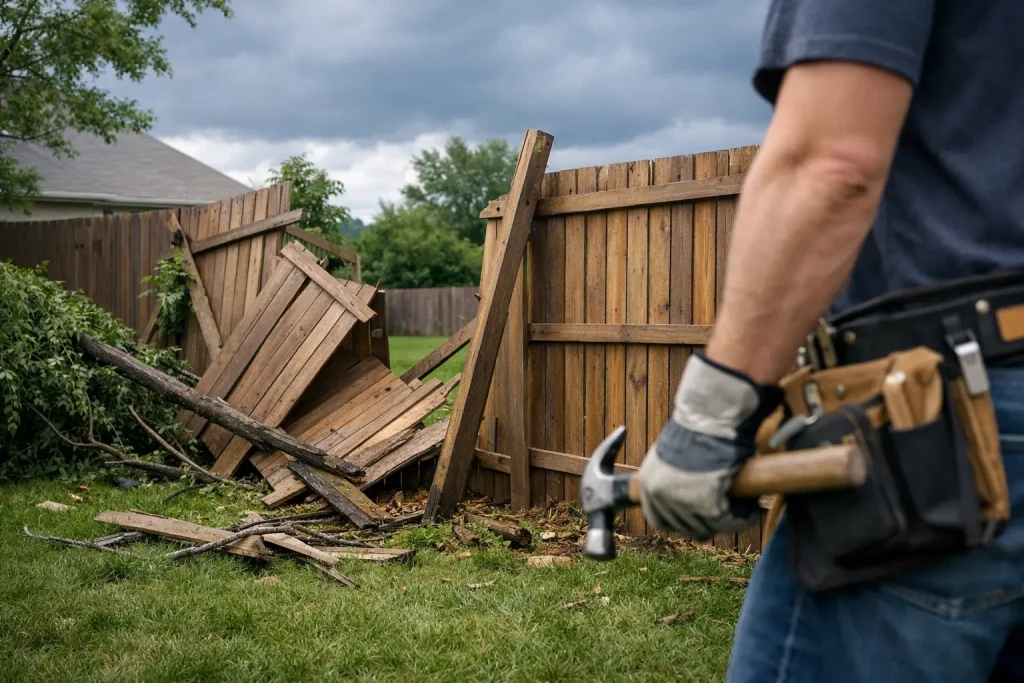
A fence rarely fails neatly in high winds. One loose panel can pull on the next, a leaning post can strain a gate, and fallen branches may leave a boundary unsafe before the weather has even settled. Prompt storm damaged fence repair helps protect your garden, privacy and security, but the first priority is always making the area safe.
For homeowners in Newtownabbey, Glengormley, Belfast and surrounding areas, wind damage is often made worse by saturated ground, mature trees and exposed garden boundaries. A careful assessment can prevent a small repair from becoming a complete fence replacement.
Make the Area Safe Before Inspecting the Fence
Do not rush outside while strong winds are still blowing. A partially detached panel acts like a sail, and unstable posts can fall without warning. Keep children, pets and visitors away from the damaged section, especially where the fence borders a driveway, pavement, shared access route or neighbouring garden.
Look first from a safe distance. Check whether any panels, rails or posts are hanging over a path, leaning towards a building, or pressing against a shed, greenhouse or vehicle. If a fence is tangled with a fallen tree or large branch, avoid trying to pull it free yourself. The timber may be carrying weight, and moving it can cause further damage to the boundary or surrounding property.
Where it is safe to do so, remove lightweight loose items from the garden, such as planters, furniture or bins, that could be blown into the remaining fence. If a gate has become loose, secure it closed temporarily only if its hinges and posts are sound. Do not force a distorted gate into position, as this can split the timber or pull a weakened post further out of line.
Check What Has Actually Failed
Wind damage can look more dramatic than it is. A single panel may have blown out while the posts and rails remain solid, making a targeted repair possible. Equally, an apparently intact fence may have posts moving in the ground, which means replacing only the visible panel will not provide a lasting result.
Start by looking along the line of the fence rather than at one damaged point. A straight boundary should not have a gradual lean, uneven gaps beneath panels or posts that sit at noticeably different angles. Pay attention to the first and last posts in a run, as these often take the greatest strain when several panels catch the wind together.
Panels, rails and fixings
Timber panels can crack, split at the frame or pull away from their supports. In some cases, new clips or brackets and a replacement panel are enough. If the horizontal rails behind the panels have snapped, however, the structure needs more than a cosmetic fix.
Loose nails and corroded screws are also worth noting. Older fences may fail in a storm because the fixings have weakened over time, not simply because the wind was unusually strong. Refastening sound timber can be practical, but only if the surrounding wood has not rotted.
Posts and foundations
Posts are the foundation of a dependable fence. If one is broken at ground level, loose in wet soil or leaning heavily, it will usually need replacement. Attempting to brace a failed post without addressing the cause may hold it briefly, but it is unlikely to stand up to the next spell of bad weather.
Concrete posts are generally more resistant to rot, though they can crack or shift if the ground moves or a heavy tree limb falls against them. Timber posts can offer a traditional appearance and are straightforward to repair section by section, but their condition below ground is particularly important. The right choice depends on the existing fence, exposure to wind, drainage and the finish you want for the garden.
Trees and nearby structures
A fence damaged by a tree is not just a fencing issue. A branch caught on panels may be under tension, while a leaning or uprooted tree can threaten a roof, outbuilding, overhead service or access route. In these circumstances, tree work and fence repair need to be planned together so the boundary is not repaired before the risk above it has been removed.
This is one reason a full site assessment matters. Abbey Tree and Fencing Services can assess storm-damaged trees and boundaries as part of the same practical job, helping protect the property while avoiding unnecessary disruption.
When a Repair Is Enough and When Replacement Makes More Sense
A repair is usually the sensible option where damage is isolated: one or two panels are broken, a rail has snapped, or a single post has failed while the rest of the fence remains firm and evenly aligned. Matching the existing panel style can keep the repair tidy and maintain a consistent appearance along the boundary.
Replacement becomes better value when damage exposes wider problems. Several leaning posts, repeated rot, failing rails and mismatched old panels can leave a fence looking patched while still offering poor security. Replacing a whole run also allows the new line to be set properly, with suitable post spacing, stronger fixings and a design that suits the level of privacy required.
There is a balance to strike. Replacing an entire boundary because of one damaged panel is not always necessary, but repeatedly repairing a fence that has reached the end of its working life can cost more over time. Honest advice should account for the fence condition, the severity of the damage, access to the garden and how exposed the site is to future wind.
Why Temporary Fixes Need Care
It is understandable to want immediate privacy after a panel blows out. A temporary board or light screening can help mark the boundary until a repair is arranged, provided it is secured safely and does not create another wind hazard. Avoid tying loose panels to weakened posts, stacking heavy objects against a leaning fence, or using thin rope as a long-term restraint.
These makeshift repairs can put extra load on the remaining structure and make a proper repair more difficult. They can also create problems with shared boundaries, particularly if a fence falls towards a neighbour’s garden. Take clear photographs of the damage before anything is moved where possible, then speak to the relevant neighbour or landlord if responsibility for the boundary is uncertain.
If you are considering an insurance claim, photographs taken after the storm, along with notes on the date and visible damage, may be useful. Cover varies by policy, so it is sensible to check the wording before authorising major replacement work. Safety work should not be delayed where a fence or tree poses an immediate risk to people or property.
Choosing a Stronger Fence After Storm Damage
A replacement fence should suit the site, not just fill the gap left by the old one. Solid closeboard or featheredge fencing can provide privacy and a strong traditional boundary, but it catches more wind than an open style. Trellis-topped panels, slatted designs and decorative screening may look attractive, yet their suitability depends on the amount of shelter around the garden.
Post depth, footing condition and drainage are just as important as the panel itself. Waterlogged ground can loosen posts, while poor spacing can leave panels unsupported. On exposed sites, a contractor may recommend stronger posts, more substantial rails or a different fence arrangement to reduce the chance of repeated storm damage.
Access also affects the approach. Narrow side passages, landscaped gardens and restricted shared lanes require careful handling of materials and spoil. A tidy contractor will protect nearby planting, keep routes as clear as possible and remove damaged fencing when the work is complete.
Arrange Storm Damaged Fence Repair Promptly
Once the weather has passed, a damaged fence is best dealt with before further rain and wind weaken it further. A professional inspection can establish whether the issue is limited to panels and fixings, whether posts need renewing, or whether tree clearance must happen first.
The most useful repair is not necessarily the quickest-looking one. It is the one that leaves your boundary stable, your access clear and your garden feeling private and secure again when the next strong wind arrives.