

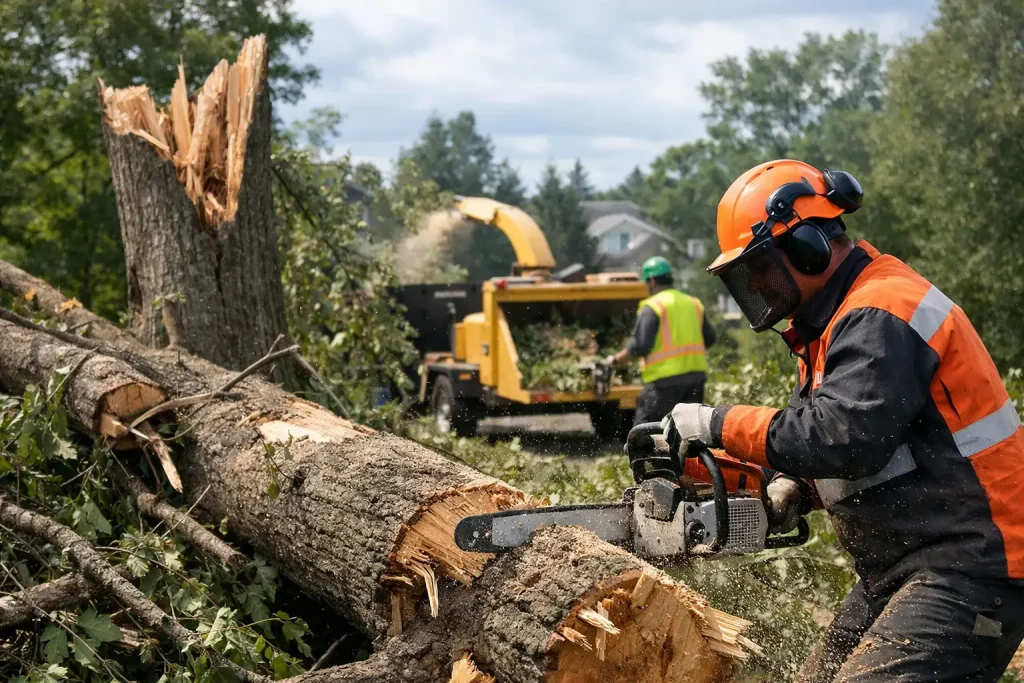
A fallen limb across the drive, a leaning trunk beside the house or a fence crushed beneath branches can turn a rough night of weather into an immediate safety concern. Storm damaged tree clearance is not simply a matter of cutting up what has fallen. The priority is to make the area safe, protect people and property, and remove damaged timber without causing further harm to the tree, garden or boundary.
For homeowners in Newtownabbey and the surrounding area, the right response depends on where the tree has failed, how much weight remains overhead and what sits nearby. A branch on an open lawn may be inconvenient. A split limb hanging above a footpath, conservatory, shed or parked car needs a careful and controlled approach.
Make the area safe before anything else
After high winds, resist the urge to pull, cut or climb around damaged branches. Storm-damaged trees can hold tension in unpredictable places. A branch that appears settled may be trapped under pressure, while a partly detached limb can fall without warning when its weight shifts.
Keep children, pets and visitors away from the affected area. If a tree or branch has come down across an entrance, use another route where possible rather than trying to drag it clear. Do not stand beneath hanging branches or attempt to use a ladder near a damaged canopy.
There are a few situations where prompt professional help is especially sensible:
- A tree, large branch or root plate is leaning towards a house, garage, vehicle or neighbouring property.
- Damaged timber is hanging over a drive, pavement, garden gate or regular access route.
- The tree has affected power or telephone lines. Keep well clear and contact the relevant network operator first where necessary.
- A fallen tree has broken fencing, blocked access or left an exposed garden boundary.
Taking a few photographs from a safe distance can help explain the situation when arranging an inspection. There is no need to get close for a better picture. Clear information about access, nearby buildings and the tree’s position is more useful than taking a risk.
How storm damaged tree clearance is carried out safely
A proper clearance job starts with an assessment, not a chainsaw. The contractor needs to check what has failed, what remains unstable and whether the tree is still structurally sound. Wind damage is not always obvious from ground level. Cracks in major limbs, torn bark, lifted roots and splits in the trunk can all affect the safest method of removal.
Assessing the tree, site and access
The first decision is whether the tree can be retained. A broken branch may be removed with a careful pruning cut, leaving the rest of the tree in good condition. In other cases, a crown reduction may reduce the load on weakened limbs and make the tree safer for the future.
Where the trunk is split, the root plate has lifted or the tree is leaning towards a building, full removal may be the sensible option. This is not about removing trees unnecessarily. It is about giving honest advice based on the condition of the tree and the risk around it.
Access matters too. A large rear-garden tree may need sections to be lowered by rope because there is no safe route for branches to fall. Narrow side passages, greenhouses, patios, sheds and neighbouring gardens all influence how the work is planned. A good contractor works around these constraints rather than treating the garden as an empty site.
Removing damaged branches in controlled sections
Storm clearance often involves dismantling rather than simply felling a tree. Damaged limbs may need to be secured, cut into manageable sections and lowered carefully to avoid rooflines, fences, paving and planting below.
This can take longer than a straightforward tree removal, particularly where branches are tangled, suspended or under tension. It is time well spent. Rushing a cut in the wrong place can send timber through a fence panel, onto a shed roof or into an adjoining garden.
Once the immediate hazard has been dealt with, the remaining tree can be checked again. Some trees need only corrective pruning. Others may need further work at a later date, once it is clear how they respond. Where removal is required, the stump can be left at ground level or dealt with separately according to future plans for the area.
Clearing the site properly
A storm can leave more than obvious branches behind. Smaller twigs, sawdust, torn bark and hidden debris can make paths slippery and lawns difficult to use. Reliable clearance includes cutting timber into manageable lengths, removing green waste where agreed and leaving access routes clear.
If logs are suitable for keeping, this can be discussed before the work starts. Freshly cut wood usually needs time to season before it is useful as firewood, so it is worth considering whether there is dry storage space available. Otherwise, removal is often the tidiest option.
Can a storm-damaged tree be saved?
It depends on the type and extent of the damage. A healthy, well-rooted tree that has lost one moderate branch may recover well after proper pruning. Removing torn or broken material cleanly can prevent further tearing and help the tree compartmentalise the wound.
A tree with exposed roots, a deep split through the main stem or a major lean is a different matter. Even if it is still standing, its stability may have been compromised. In a domestic garden, especially near homes and access routes, the safer long-term choice may be removal.
Do not judge the tree only by whether it still has leaves or looks upright from one angle. Root damage can be hidden underground, and a trunk can remain standing despite a serious internal split. An on-site inspection gives a clearer picture than guesswork after a storm.
Protecting fences, gates and garden boundaries
Tree damage and fencing damage often arrive together. A heavy branch can crack concrete posts, pull panels from their fixings, bend a timber gate or weaken a boundary line that was already ageing. Clearing the tree without checking the fence can leave the garden less secure and exposed to the next spell of wind.
It is worth inspecting posts as well as panels. A panel may look like the only damaged part, but a shifted or cracked post can make a replacement panel unstable. Similarly, a gate that no longer closes properly may have suffered hinge damage or movement in the supporting post.
Where clearance work takes place close to a boundary, the aim should be to protect what can be saved and recommend practical repairs where needed. In some cases, replacing one panel or section is enough. If an older fence has failed along several points, a new boundary line may offer better privacy, security and value over time.
Why DIY clearance can make damage worse
Small, fully grounded twigs in an open part of the garden can usually wait for ordinary garden tidy-up. Anything larger, elevated, twisted or close to a structure is another matter. Domestic chainsaws, ladders and improvised ropes are a poor combination around storm-damaged timber.
The main risk is not just injury while cutting. Removing one branch can release the weight of another, alter the tree’s balance or cause a partly supported limb to swing unexpectedly. Damage to roofs, fences and cars can quickly cost more than arranging professional assistance from the outset.
Be wary of anyone offering an immediate, vague price without looking carefully at the site. A clear quotation should reflect the tree’s condition, access, equipment required, waste removal and any additional work needed to make the area safe. The cheapest option is not always the one that protects your property best.
Planning for the next spell of bad weather
Once the urgent work is complete, consider what will reduce future risk. Mature trees benefit from occasional inspection, particularly after a period of rapid growth, disease, previous pruning or repeated exposure to strong winds. Deadwood removal, crown reduction and sensible maintenance can reduce the chance of branches failing over paths, fences and buildings.
It is also sensible to look at what lies beneath the tree. Moving garden furniture, keeping gutters clear and addressing weakened fence sections before winter can limit the damage caused when weather turns. A tree does not need to be removed simply because it is large, but it should be managed with its setting in mind.
Abbey Tree and Fencing Services provides safety-focused storm clearance for homeowners who need straightforward advice, careful work and a tidy finish. The best time to assess a vulnerable tree is before the next storm turns a manageable concern into a blocked drive, broken boundary or urgent callout.