

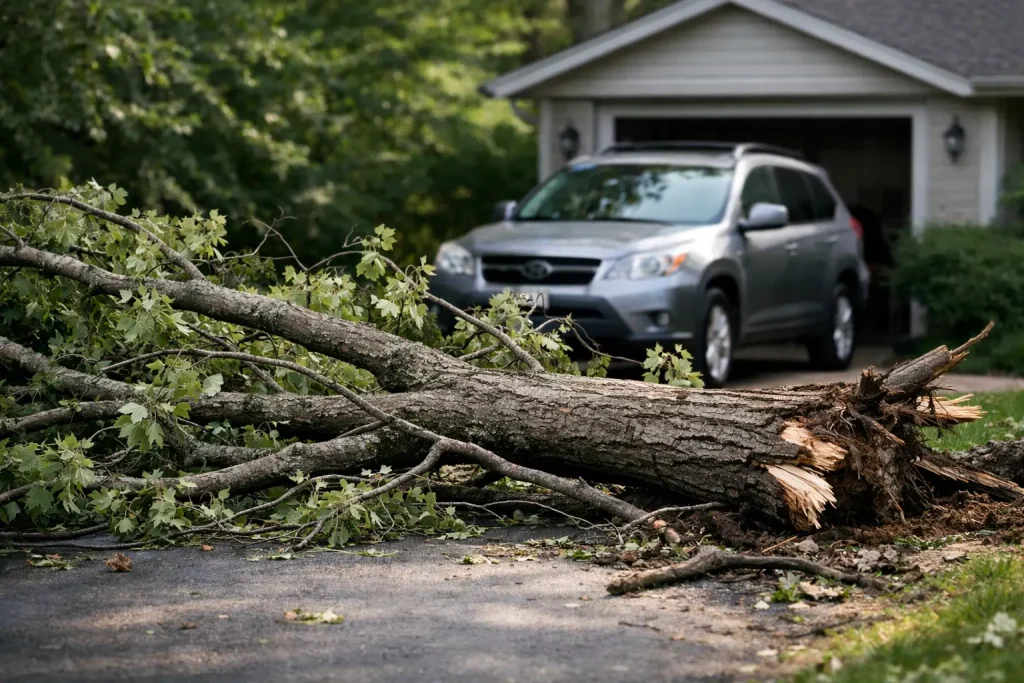
A tree blocking driveway access can turn an ordinary morning into a real problem, particularly when a car is trapped, deliveries cannot get through or someone needs to leave quickly. Whether the obstruction is a fallen tree after high winds, a low limb, a leaning trunk or a hedge that has spread into the entrance, the priority is to keep people, vehicles and nearby property safe before trying to clear the way.
For homeowners across Newtownabbey, Glengormley, Belfast and the surrounding area, the right solution depends on what has caused the blockage, where the tree is growing and how stable it is. A careful assessment avoids making a manageable access issue into damage to a vehicle, fence, gate or building.
Do not force your way past the tree
It is tempting to squeeze a car under a branch or move a small-looking limb by hand. That can be risky. Branches under tension can shift suddenly, and a tree that has fallen across an entrance may still be held up by a fence, gatepost, vehicle or another branch. Moving one piece can release weight elsewhere.
Keep vehicles clear of the area where possible. Do not park beneath hanging branches, and keep children and pets away from the obstruction. If the tree has brought down an overhead cable, is touching a power line or has damaged a utility box, stay well clear and report it to the relevant emergency utility provider. Tree work close to live services needs specialist precautions.
Where emergency access is affected, explain that clearly when arranging help. A blocked driveway is more urgent when it prevents an essential journey, stops a vulnerable resident leaving the property or restricts access for emergency services.
Work out what is blocking the entrance
A clear description helps a tree contractor decide what equipment, labour and access arrangements may be needed. From a safe distance, look at whether the issue is a whole tree, a major limb, overgrown lower growth or roots affecting the driveway surface.
Fallen or storm-damaged trees
Storm damage is often the most urgent scenario. A tree may be completely down, partly uprooted or caught in another tree. Splits in the trunk, lifted soil around the root plate, cracked heavy limbs and a sudden lean all suggest instability. These are not jobs for a household chainsaw.
A professional team can dismantle and remove damaged sections in a controlled order, rather than cutting at random and causing the remaining weight to move. They will also consider where timber can be lowered safely, especially where there are gates, boundary fencing, parked cars or neighbouring property close by.
Low branches and overgrown canopies
Not every blockage requires removal. A healthy tree may simply have grown lower or wider over time, leaving too little clearance for cars, vans or a mobility vehicle. Selective pruning or crown lifting can restore practical entrance space while retaining the tree’s shape, health and value in the garden.
The amount removed should be proportionate. Cutting back too severely may leave a tree stressed, exposed or prone to producing weak regrowth. Honest advice should focus on the clearance required now and the maintenance needed to stop the issue returning too quickly.
Roots lifting the driveway
Roots can create a different sort of obstruction. They may lift paving, crack tarmac or make the entrance uneven enough to catch the underside of a car. Cutting major roots without understanding their role can destabilise the tree or lead to decline, so the driveway and tree need to be considered together.
Sometimes a local surface repair or a redesigned edge is enough. In other cases, removal may be the safer long-term choice, particularly if the tree is already in poor condition or too close to the entrance. There is no one-size-fits-all answer.
Check ownership before arranging major work
A tree growing within your boundary is usually your responsibility, but trees close to shared driveways, neighbouring gardens, adopted roads or public land can make matters less straightforward. If the trunk sits on a boundary or the tree appears to belong to a neighbour, speak to them before substantial work is carried out where circumstances allow.
You may generally cut back growth that crosses into your property, but that does not automatically make it wise to remove large limbs. The work must not make the tree unsafe, and cut material still belongs to the tree owner unless they agree otherwise. A contractor can help identify a sensible scope of work and explain what can be done safely from your side.
Some trees are protected by a Tree Preservation Order or are within a conservation area. Before non-emergency pruning or removal, check whether consent or notice is required through the local planning authority. In a genuine emergency, only the minimum work needed to make the situation safe should be undertaken, with clear records and photographs kept where possible.
Why professional clearance is usually the safer option
Driveway entrances are awkward work areas. There is often limited room for equipment, restricted sight lines, overhead cables, brick pillars, gates and vehicles that cannot easily be moved. A tree surgeon plans the job around these constraints rather than treating the tree as an isolated obstacle.
A safe approach may involve sectioning the tree down from above, using lowering ropes to protect a fence, or cutting and removing a fallen stem in carefully controlled lengths. The best method depends on the tree’s condition, available space and what needs protecting below it.
Fully insured, safety-focused work also matters when the obstruction has already caused damage. A contractor should assess not only the obvious branch across the drive, but also any remaining split limbs, damaged stems and weakened fence sections. Clearing the visible blockage while leaving a dangerous hanging branch overhead is not a proper solution.
Protect gates, fencing and the driveway during the work
Trees commonly catch fences and gates as they fall. Even a branch that appears light can place enough sideways pressure on a panel or post to loosen it. Before cutting begins, the team should identify what is supporting the tree and what could move once weight is removed.
Where a fence has been pushed out of line, it may be sensible to clear the tree first and then assess whether the post, rails and panels can be repaired or need replacing. Trying to straighten a fence while it is still carrying tree weight can worsen the damage.
Driveways need care too. Heavy timber dragged over block paving, gravel or tarmac can leave marks and ruts. A tidy contractor will plan timber handling, protect vulnerable areas where practical and remove branches, sawdust and debris once the work is complete. The aim is not merely to reopen access, but to leave the entrance safe and presentable.
Plan for access before the next storm
Once the immediate blockage has been dealt with, it is worth looking at why it happened. Mature trees often give early warning signs: deadwood over the drive, limbs rubbing against each other, dense growth catching the wind, decay around old pruning wounds or a canopy extending well beyond its previous shape.
Planned maintenance can reduce the chance of a future emergency. This might mean removing deadwood, reducing a long overextended limb, raising the canopy above the drive or improving clearance around gates and visibility splays. It should preserve as much healthy growth as possible while dealing with the actual risk.
For trees beside a narrow entrance, consider the largest vehicle that reasonably needs access. A family car may pass comfortably while a delivery van, ambulance or tradesperson’s vehicle cannot. Discussing this during an assessment leads to a more useful clearance height and width than trimming only to suit the car currently on the drive.
Abbey Tree and Fencing Services provides practical assessments for blocked access, storm-damaged trees and boundary damage, with a focus on safe working, straightforward advice and a tidy finish. A clear quotation should explain the recommended work, any likely access limitations and what will happen to the arisings.
A blocked entrance can feel urgent, but it does not call for a rushed cut or a risky DIY attempt. Keep the area clear, record the damage if safe to do so, and arrange a professional assessment. Restoring access properly protects more than the driveway – it helps safeguard the people, vehicles, trees and boundaries around it.