
A mature tree can be an asset to a garden, but not when a leaning trunk, heavy limb or spreading root system is too close to the house. Searches for “tree removal near house” often follow a worrying moment: branches scraping a roof in high winds, a cracked boundary panel, blocked light, or a tree that suddenly looks less stable than it did last season.
Removing a tree beside a property is not simply a matter of cutting it down. The work needs a planned approach that protects the building, nearby fencing, garden features, neighbouring land and safe access. The right solution may be full removal, but it can also be a crown reduction or targeted removal of unsafe branches. Honest advice starts with looking at the tree and its surroundings properly.
Why tree removal near a house needs careful planning
A tree does not fall neatly into an open field when it is growing beside a home. There may be a conservatory, roofline, overhead cables, sheds, patios, parked cars or a narrow shared access route beneath it. Even a small tree can cause expensive damage if sections are cut or lowered without control.
The first job is to assess the whole site, not just the trunk. A professional tree surgeon will consider the tree’s height, lean, condition and branch weight, alongside the available working space. Deadwood, decay, storm damage and split limbs can change how the tree is dismantled. Access matters too: a rear garden with no side gate calls for a different method from a front drive with clear vehicle access.
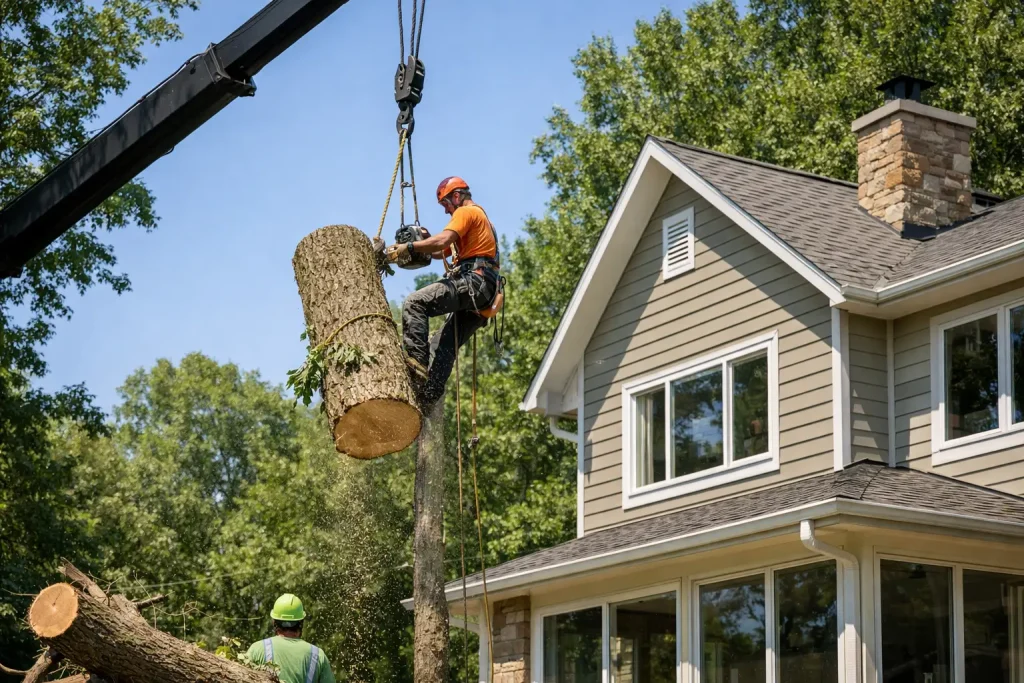
Where there is a risk to a roof, fence or neighbouring garden, the tree is usually removed in manageable sections rather than felled in one piece. Climbers can take down branches carefully, with ground staff controlling and lowering material where needed. It takes longer than a quick cut at the base, but it is the sensible way to keep disruption and risk under control.
Signs a tree may need work
Not every tree close to a house needs to be removed. Healthy trees can often be managed safely for many years through appropriate pruning. However, there are warning signs that deserve a proper inspection.
Look out for a noticeable new lean, large dead branches, cracking at major branch junctions, cavities in the trunk, mushrooms or fungal growth around the base, and roots lifting paving or pushing against structures. A canopy that has become heavily unbalanced can also put extra strain on the tree in strong winds.
Branches touching gutters, tiles or windows should not be ignored. Repeated rubbing can damage roof materials, while leaves and twigs may block gutters and downpipes. If the concern is shade, overhang or light blockage rather than structural weakness, crown reduction may provide the result you need without removing the entire tree.
It depends on the species, age, condition and location. A good contractor will explain whether removal is necessary, or whether lower-impact maintenance is the more practical and cost-effective choice.
Storm damage needs a fast, measured response
After high winds, a tree can look sound from ground level while a partially broken limb remains caught in the canopy. That limb may fall later, particularly during further wind or rain. Do not attempt to pull down hanging branches, climb the tree or work underneath damaged sections.
Keep people, pets and vehicles clear of the area. If a tree has come into contact with power lines, stay well away and report it to the relevant network operator. For a tree threatening a roof, access route or boundary, emergency tree work can make the site safe before a full assessment and tidy-up are completed.
How a safe removal is carried out
The exact method should suit the property, rather than forcing the property to suit the method. On a clear site, a small tree may be felled safely in a controlled direction. Beside a house, however, sectional dismantling is commonly the safer option.
The work normally begins by establishing a safe working area and protecting vulnerable surfaces where practical. Branches are removed in stages to reduce the canopy’s weight and give the climber a controlled route through the tree. Larger pieces can be lowered by rope rather than dropped, helping to protect roofs, greenhouses, paving and garden boundaries.
Once the canopy is cleared, the main stem is reduced in sections. The final stump can be left low and neat, or removed by stump grinding if you want to reclaim the area for turf, planting, paving or a new fence line. Stump grinding is often worthwhile where a remaining stump would obstruct access or spoil the finish of the garden, although it may not be necessary in a tucked-away corner.
Good tree work should not leave a garden covered in sawdust, branches and timber offcuts. Material can be removed from site or processed as agreed, and the work area should be left clear and tidy. This matters especially where removal takes place beside a driveway, path or shared access.
Protecting fences, gardens and neighbouring property
Trees and fences are often closely connected. Roots can displace posts, branches can crush panels, and a falling limb can damage a boundary that was already weathered. Before work begins, it is sensible to identify which fences, gates, sheds and planted areas need particular protection.
Where access is limited, cut material may need to be carried through the garden by hand. This can be slower, but it avoids forcing machinery across lawns or tight pathways. If a fence has been damaged by the tree or needs temporary removal for access, repairs or replacement can be planned as part of putting the garden back in order.
Neighbouring property should be considered from the outset. A tree may overhang another garden, and work can affect shared driveways or access routes. Clear communication before the job helps prevent avoidable surprises. It also gives everyone a chance to move vehicles, garden furniture and vulnerable items away from the work area.
Check permissions before work starts
Some trees are protected by a Tree Preservation Order or are within a conservation area. In those cases, permission or formal notice may be required before pruning or removal takes place. The rules can apply even when the tree is in your own garden, so it is never wise to assume that proximity to the house automatically gives permission to remove it.
If you are unsure, raise the question during the quotation stage. A careful contractor can help you understand what needs checking before dates are arranged. This avoids unnecessary delay, potential enforcement action and the cost of arranging work that cannot go ahead as planned.
Preparing your property for tree work
You do not need to turn your garden into a building site, but a little preparation makes the day run more smoothly. Move cars from the drive and clear any access needed for the team and equipment. Take garden furniture, pots, children’s toys and washing lines out of the immediate work area.
Let the contractor know about hidden features such as septic tanks, shallow pipes, delicate paving, garden lighting or recently planted beds. If there is a shared lane, school-run traffic or restricted parking outside the property, mention this when arranging the visit. These details help the work be planned safely rather than dealt with at the last minute.
It is also helpful to discuss what you want from the finished space. If the tree is being removed to improve light, create room for a patio or install a stronger boundary, the stump position and clean-up can be tailored to what comes next.
Choosing a contractor you can trust
Tree work near a house is not the place for guesswork or a price based only on a photograph. A site visit allows the contractor to see access restrictions, assess the tree’s condition and give a clear quotation for the work required. Ask what method will be used, whether waste is included, how nearby structures will be protected and what the site will look like when the job is finished.
Insurance and safe working practices matter because the consequences of poor tree work can be serious. So does straightforward communication. You should know whether the recommendation is full removal, reduction or maintenance, why it has been made, and what is included in the price.
Abbey Tree and Fencing Services provides reliable, tidy and safety-focused tree work for homeowners across Newtownabbey and the surrounding area. Each job is assessed around the property, access and long-term outcome, with practical advice rather than unnecessary upselling.
If a tree is making you uneasy every time the wind picks up, arrange an assessment before it becomes an emergency. A careful inspection can turn an uncertain problem into a clear plan, leaving your home, boundary and garden safer and easier to enjoy.