

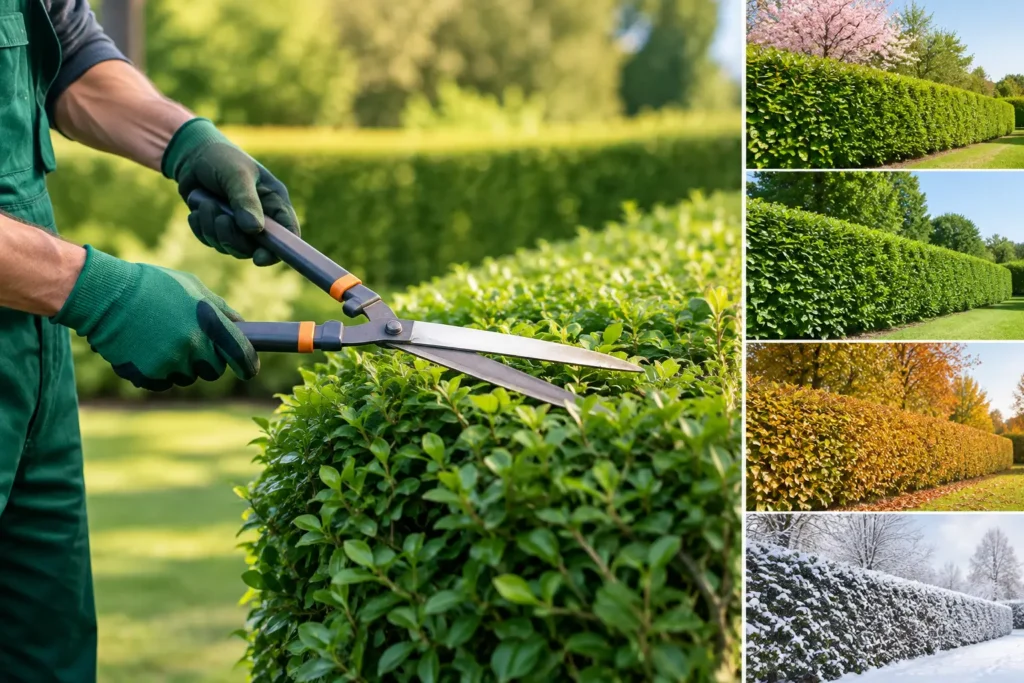
A hedge can go from a neat garden boundary to a problem surprisingly quickly. It starts to block light from a window, narrows a path, leans over a fence or leaves the garden looking untidy. If you are asking when should hedges be trimmed, the short answer is that it depends on the hedge species, its condition and whether birds are nesting. The right timing keeps a hedge dense, healthy and useful for privacy, without causing avoidable damage.
For most homes around Newtownabbey and Belfast, regular light trimming is better than leaving a hedge to become overgrown and then cutting it back severely. A planned approach also makes it easier to protect nearby fencing, gates, sheds and neighbouring boundaries.
When should hedges be trimmed through the year?
Many evergreen hedges benefit from a main trim in late spring or early summer, once the first flush of strong growth has settled. Fast-growing hedges may then need a second lighter cut in late summer. This is often enough to restore a clean line and prevent the hedge from becoming too wide without shocking the plants.
Late summer is particularly useful for formal hedges where you want them to look tidy through autumn and winter. A carefully timed cut encourages a smart finish while avoiding the tender new growth that can be damaged by an early frost.
Winter can be suitable for some deciduous hedges, especially if they need more substantial maintenance while dormant. However, it is not automatically the best answer for every hedge. Heavy winter cutting can leave a boundary looking bare for several months, so homeowners who rely on the hedge for screening may prefer staged work instead.
The season gives a helpful starting point, but the hedge itself should make the final decision. Its species, the amount of growth removed and the conditions on the day all matter.
Check for nesting birds before hedge cutting
Before any hedge is trimmed, it should be checked carefully for signs of active bird nests. In the UK, wild birds, their nests and eggs are protected by law. It is an offence to intentionally take, damage or destroy an active nest, and nesting can take place outside the period people usually associate with spring and summer.
For that reason, avoid assuming that a hedge is clear simply because it is late in the season or because you cannot immediately see a nest. Watch for regular bird movement into one area, low branches that provide cover, or a nest tucked deeper inside dense growth. Where active nesting is suspected, the work should wait until the young birds have left.
A professional hedge cutter will assess this before starting, rather than treating a planned date as more important than wildlife protection. That careful approach also helps avoid pulling apart sections of hedge that are supporting other garden wildlife.
The best time depends on the type of hedge
Different hedges respond very differently to trimming. Cutting at the wrong time, or cutting too hard, can lead to patchy growth, bare areas or a hedge that never properly regains its shape.
Leylandii and other conifer hedges
Leylandii is one of the most common sources of hedge-cutting enquiries because it grows quickly and can soon block light or overtake a boundary. It is usually best maintained with light, regular trims during the growing season, often from late spring onwards, with a final tidy-up in late summer if needed.
The key point with conifers is to avoid cutting back into old, brown wood. Unlike many broadleaf hedges, conifers may not produce new growth from these bare areas. Once a leylandii hedge has become too tall or wide, bringing it back down can be limited by where the green growth remains. Early action gives far better options and a neater long-term result.
Privet, yew and other evergreen hedges
Privet generally copes well with regular trimming and can be cut after its main growth period in late spring, then again later in summer if it is growing strongly. Yew is slower but very tolerant of pruning, making it a good choice for formal shapes. A light summer trim usually maintains its outline, while more significant work is often better planned for the dormant season.
Do not remove too much at once simply to get a hedge back to its original size. Reducing it gradually can protect the plant’s health and maintain privacy while it recovers.
Beech and hornbeam hedges
Beech and hornbeam are deciduous, but they often hold onto their dry leaves through winter, giving useful screening. These hedges are commonly trimmed in late summer to preserve that tidy, dense appearance through the colder months.
If a beech or hornbeam hedge needs reshaping, it is worth considering how much screening you are prepared to lose temporarily. A hard cut may be practical from a maintenance point of view, but it can leave a garden exposed until fresh growth returns.
Flowering and native mixed hedges
Flowering hedges should usually be cut after they have finished flowering. Trimming too early can remove the season’s display, while cutting at the wrong point may reduce berries that support birds later in the year.
Native mixed hedges need an especially considered approach. They can contain several species growing at different rates, along with thorny branches, self-seeded saplings and dense interior growth. They may need selective pruning rather than a uniform clip, particularly where the aim is to improve access while keeping the hedge’s natural character.
Signs that a hedge needs attention now
A calendar is useful, but there are practical warning signs that tell you it is time to arrange a trim. If the hedge is spreading into a driveway, covering a footpath, obstructing sight lines near a gate or pressing on a fence, it should not be left until the ideal season without an assessment.
Similarly, a hedge that is becoming thin at the bottom may need a change in how it is maintained. Cutting the top too flat or allowing the upper growth to become much wider than the base can starve lower branches of light. A slightly tapered shape, wider at the bottom and narrower at the top, helps light reach the whole hedge and supports denser growth from ground level.
Other signs include branches rubbing on fences, damp patches where overgrowth restricts air movement, and tall growth that is becoming unsafe to reach from ground level. What looks like a straightforward garden job can become a working-at-height issue, especially beside uneven ground, overhead cables, glasshouses or public paths.
Avoid trimming in poor conditions
A dry, mild day is generally best for hedge work. Cutting during a hard frost can damage freshly cut growth, while work during very hot, dry weather can add stress to the plant. Wet conditions make the job messier, increase the chance of slipping and can leave clippings spread across lawns, patios and access routes.
It is also sensible to avoid rushing into major cutting after a storm. Storm-damaged branches may be under tension, caught in fencing or hanging over sheds and pathways. In these cases, the priority is safe clearance and protecting the surrounding property, rather than trying to shape the hedge immediately.
How much should be removed?
For routine maintenance, a light cut that removes the current season’s excess growth is usually the safest option. It keeps the line controlled and avoids creating large bare patches. The exact amount depends on the species, but taking a little and returning regularly is normally preferable to a severe annual cut.
An overgrown hedge may need more than one visit over one or two growing seasons. This can feel slower, but it gives the hedge time to respond and helps retain the privacy and shelter that made it valuable in the first place. It is also a sensible way to manage hedges sitting close to fences, walls and neighbouring gardens.
When a hedge has become too large for safe domestic equipment, or its condition is unclear, professional advice is worthwhile. A clear assessment can establish what can be reduced, whether the hedge will regrow well, and how the work can be completed without damaging the boundary below it.
A well-timed trim is not about making every hedge look identical. It is about keeping your garden private, accessible and cared for while giving the plants the best chance to stay thick and healthy. If your hedge is affecting light, access or a fence line, Abbey Tree and Fencing Services can provide honest advice and a tidy, safety-focused plan for putting it right.