

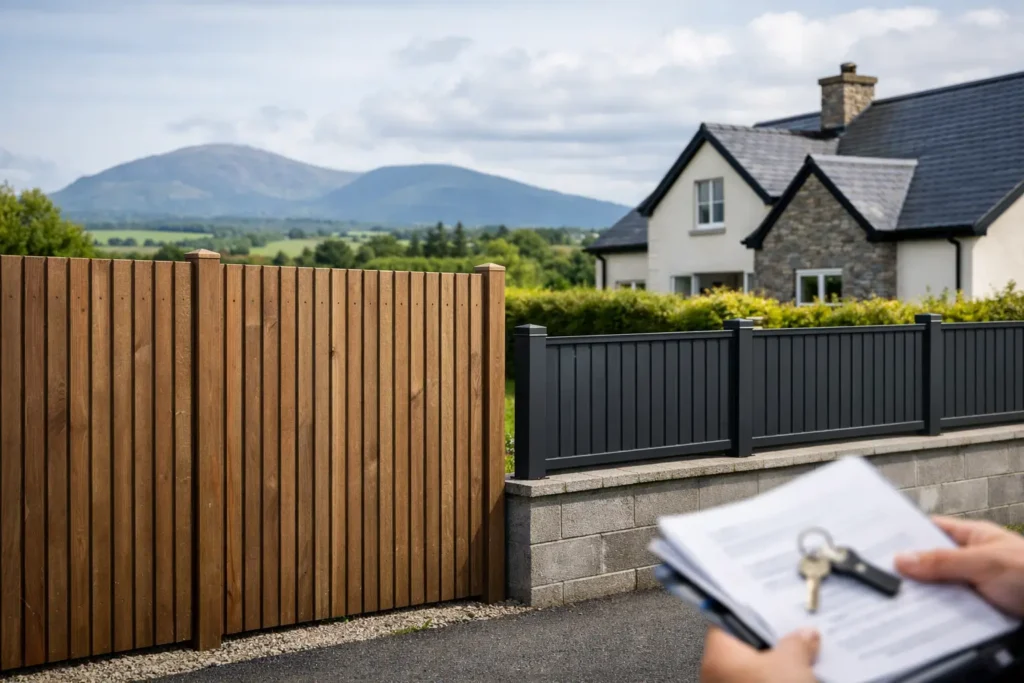
A new fence can make a garden feel safer, more private and far better kept – but it is frustrating to have work completed only to find that its height or position needs to be changed. So, does fence height need permission? In Northern Ireland, the answer usually depends on where the fence sits, how high it will be and whether your property has any planning restrictions.
For many homes in Newtownabbey, Glengormley and the wider Belfast area, a straightforward rear or side garden fence can be installed without a planning application. Front boundaries and plots beside roads need more care. Checking the details before posts go in is the sensible route, particularly where privacy, security or an uneven site has led to plans for a taller boundary.
Does fence height need permission for a home?
The usual permitted development guidance for a house allows a gate, fence, wall or other enclosure up to 2 metres high without planning permission. This is normally the relevant limit for a rear garden boundary or a side boundary that does not adjoin a road.
Where the fence is next to a road used by vehicles, the usual maximum is lower: 1 metre. This commonly affects front gardens, corner plots and side boundaries that run alongside a public road. It is easy to assume a side fence is treated like a rear fence, but the road-facing position can change the answer.
These are general planning allowances, not a guarantee that every proposed fence is permitted. Conditions attached to a previous planning approval, the type of property, local planning controls and the exact position of the boundary can all matter. If there is any doubt, ask the local planning authority for confirmation before committing to materials or installation.
Why the position matters as much as the height
A 1.8-metre closeboard fence at the back of a private garden is very different from the same fence across a front boundary. At the front, a high solid panel can reduce visibility for people pulling onto the road, block sightlines near a junction or make a small frontage feel enclosed. That is why lower limits often apply beside highways.
Corner properties deserve particular attention. A boundary that feels like a side garden line may still be adjacent to a road. Before choosing the height, consider where vehicles enter and leave, whether pedestrians need a clear view and whether bins, gates or parked cars already restrict visibility.
It also helps to establish the actual boundary line. Old fencing is not always positioned precisely on the legal boundary, especially where gardens have been altered over the years. A fence built in the wrong place can cause an neighbour dispute even if its height does not need planning permission. Title plans, deeds and a calm conversation with the neighbouring owner can prevent an avoidable problem.
Situations where permission or extra checks may be needed
Planning permission may be required where the proposed fence exceeds the relevant height limit. A 2.1-metre rear fence, for example, should not be treated as a minor difference. Height is generally taken from the ground level on the relevant side, which can be important on sloping gardens or where a neighbour’s garden sits lower.
Extra checks are also worthwhile if the property is listed, lies in a conservation area or is subject to a specific planning condition. Permitted development rights can be restricted in these cases. Flats, maisonettes and some newer developments may not have the same rights as a detached or semi-detached house, while leasehold homes can have separate restrictions in their lease or estate rules.
A fence used as part of another structure can also need a closer look. For example, adding tall panels on top of a retaining wall may create a combined height that causes planning or safety concerns. A retaining wall holding back soil is not simply a fence, and it needs to be sound enough to deal with ground pressure and drainage. On a raised deck, balcony or elevated garden, a privacy screen may also be assessed differently from an ordinary boundary fence.
If the aim is to replace a damaged fence like-for-like at the same height and position, planning is less likely to be an issue. Even then, do not assume an existing over-height fence proves that a replacement is acceptable. The original installation may have had permission, may pre-date current rules or may never have been approved.
Planning permission is not the only consideration
A fence can meet planning limits and still be the wrong choice for the site. A very tall, solid boundary may catch the wind, put more strain on posts and cast unwanted shade over a neighbour’s garden. In exposed areas around coastal or open ground, stronger posts, suitable concrete or timber supports, and correct depth are essential for a fence that will stay straight through poor weather.
Privacy and neighbour relations need a balanced approach too. A taller fence may solve overlooking from one angle but make another garden feel boxed in. Where a modest increase in screening is needed, a combination of a sensible fence height and carefully managed planting can often look better than forcing a full-height solid barrier into a tight space.
Ownership is separate from planning. The familiar idea that one side of a fence automatically belongs to one neighbour is not a reliable rule. Check deeds where possible, especially before removing an old fence, cutting back growth around it or placing new posts close to it. If a shared boundary is unclear, agreeing the work in writing is often worthwhile.
A practical way to plan your new boundary
Start by measuring from the existing ground level, not from the top of a raised flower bed, sleeper edge or retaining feature. Measure in several places if the ground slopes. A fence that looks level from the patio can be substantially higher at the neighbour’s side.
Next, identify whether any part of the proposed boundary adjoins a road. This includes a road along the side of the property, not just the driveway entrance. Consider gate swing, visibility and access for vehicles before deciding on solid panels, decorative trellis or a lower frontage treatment.
Then check for property-specific restrictions. Look through planning paperwork and title information, and speak to the local council planning team if the height, location or property status is unclear. Written confirmation is useful where a project is close to the limit or where there is a history of boundary concerns.
Finally, choose a construction suited to the job. A privacy fence needs secure posts and fixings. A security boundary may benefit from stronger materials and a lockable gate. A simple repair should blend neatly with the existing run while dealing with the reason it failed, whether that is rotten timber, loose posts, storm damage or ground movement.
Choosing a height that works for the long term
The maximum permitted height is not always the best height. For many rear gardens, 1.8 metres gives useful privacy without an overly heavy appearance. Lower fencing can keep a front garden open and welcoming, while a carefully positioned gate can improve security without obstructing sightlines.
Material makes a difference as well. Closeboard fencing offers a solid, traditional finish and can suit a long boundary. Slatted styles can soften the appearance and allow some airflow, although their screening level depends on the gap and viewing angle. Trellis is often useful above a lower fence where permitted, but its overall height still needs to be considered.
Good installation is as important as the panels themselves. Posts need to be aligned, set to an appropriate depth and protected against movement. Gravel boards can reduce contact between timber and damp soil, helping the fence stay tidier for longer. A well-planned fence should improve the boundary without creating awkward gaps, unstable corners or difficult access for future maintenance.
When to ask a professional for advice
It is sensible to seek advice before work begins if your garden slopes, the boundary meets a road, the fence will be near 2 metres, or there is a retaining wall, mature hedge or tree close by. Roots, underground services and restricted access can all affect the safest installation method.
A local fencing contractor can assess the practical side of the project: the condition of the existing line, access for materials, the right post system and how to leave the garden neat once work is complete. Abbey Tree and Fencing Services provides clear, site-specific recommendations for homeowners who want a secure, tidy boundary built with care.
The best next step is a simple one: measure the proposed fence, check whether it faces a road, and confirm any local restrictions before choosing its final height. That small amount of preparation helps protect your privacy, your investment and good relations on both sides of the boundary.