

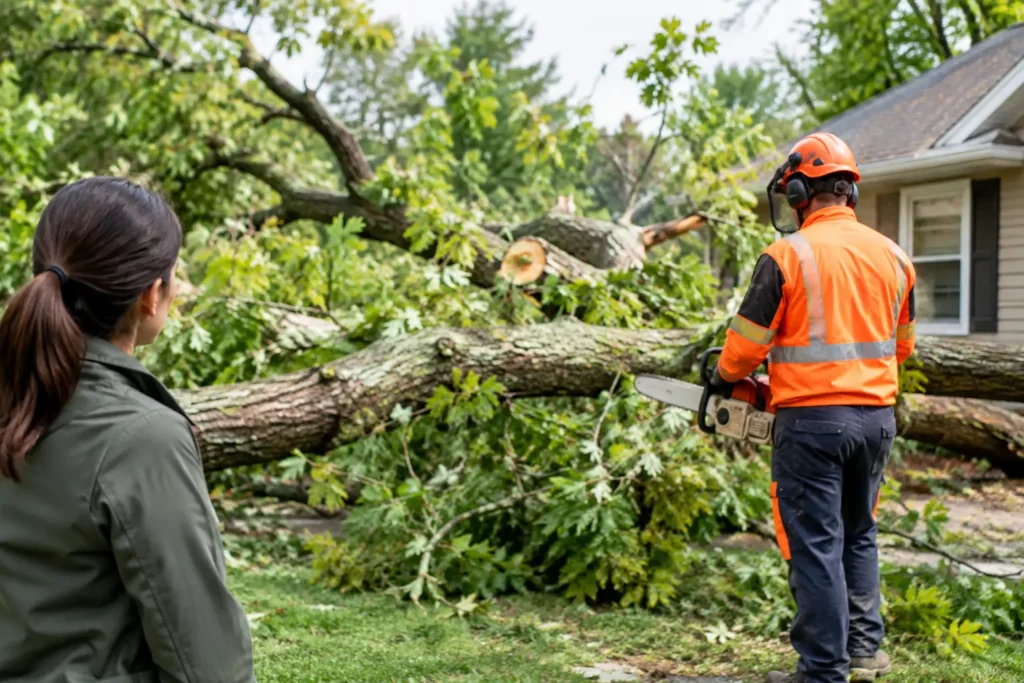
A tree does not need to be completely on the ground to be an emergency. A mature branch hanging over a driveway, a trunk that has shifted after high winds, or roots lifting beside a boundary fence can all create a serious risk. This emergency treework response example shows what a safety-led contractor should do when a homeowner needs prompt, practical help.
The priority is not to make the garden look tidy straight away. It is to make people, buildings, vehicles, access routes and neighbouring properties safe, then clear and repair the affected area properly. A rushed job without a clear plan can cause more damage than the storm itself.
A realistic emergency treework response example
Imagine a homeowner in Newtownabbey wakes after an overnight storm to find that a large conifer has partially failed. The lower trunk is still held in place, but the top section is leaning across the garden and resting against a timber fence. One heavy branch is above the driveway, where the family car is parked. The fence has bowed, and access to the side gate is blocked.
The homeowner should keep everyone away from the tree, including pets, and avoid trying to pull branches clear. Fallen or tensioned timber can move without warning. If the tree is close to overhead electrical lines, it should be treated as especially hazardous and left alone while the appropriate emergency advice is sought.
When the contractor receives the call, useful details include the property location, whether anyone is in immediate danger, what the tree is resting on, whether access is blocked, and clear photographs if they can be taken from a safe distance. This helps the team judge the urgency, prepare suitable equipment and give straightforward initial advice.
In this example, the contractor arranges an urgent visit because the tree is unstable, the driveway may be needed for vehicles, and the damaged fence is no longer providing a secure boundary. The aim is to deal with the immediate hazard first, not to sell unnecessary additional work.
The first site check: safety before cutting
On arrival, the site is assessed from a safe position before any cutting begins. A professional team looks at the direction of lean, cracks or splits in the trunk, disturbed soil around the root plate, trapped branches, nearby sheds, roofs, fences, vehicles and neighbouring gardens. They also consider how timber can be lowered and removed without worsening the situation.
This matters because a storm-damaged tree is rarely predictable. A branch that appears to be resting safely may be under compression or tension. Cutting in the wrong order can release stored force and cause it to spring, roll or drop. The condition of the tree, available working space and the location of nearby structures all affect the method used.
In the example, the driveway is temporarily kept clear and the area beneath the leaning section is cordoned off. The car is moved only if it can be done without entering the danger area. If safe removal requires a controlled dismantle rather than a simple cut-and-clear job, that is explained plainly before work starts.
Making the area safe in the right order
The crew does not begin by attacking the biggest visible branch. They first remove accessible, low-risk debris that is blocking safe movement around the garden. This creates working room and reduces trip hazards. They then address the pieces most likely to fall or shift, using the appropriate climbing, lowering or ground-based methods for the site.
Where a section is suspended over a fence or garden structure, it may need to be secured and lowered in manageable pieces. This takes longer than dropping it into an open field, but it protects the property and gives better control. A reliable emergency response is not measured by speed alone. It is measured by whether the risk has been removed without creating a second problem.
For the leaning conifer, the unstable crown is dismantled in sections. Each piece is lowered away from the driveway and boundary where possible. Once the top weight has been removed, the remaining stem can be assessed again. Depending on its condition, it may be safely retained at a reduced height, or it may need full removal if it has lost structural stability.
It depends on what the inspection shows. Honest advice is essential here. A tree with minor storm damage may only need a careful crown reduction and removal of broken limbs. A tree with a split stem, lifting roots or major decay may no longer be suitable to keep near a home or boundary.
Protecting fences, gates and access routes
Storm-damaged trees frequently affect more than the tree itself. Fences take the impact of falling branches, gates become misaligned, and gravel paths or driveway edges can be churned up during clearance. For homeowners, the practical concern is often simple: can the garden be made safe, private and usable again?
In this case, the crew removes the fallen timber from the fence before attempting repairs. Trying to straighten a panel while it is still carrying weight can snap posts or pull an entire run out of line. Once the treework is complete, the damaged sections can be checked properly.
A bowed timber panel may be repairable if the posts remain firm and the rails are sound. If the impact has cracked posts, loosened concrete footings or damaged several connected panels, replacing the affected section is usually the more durable option. Matching the repair to the existing boundary matters, especially where privacy and security are concerns.
Access also needs attention. A clear driveway and side entrance are valuable after an emergency, whether residents need to leave for work, receive deliveries or allow insurers and tradespeople onto the property. Timber, sawdust and smaller debris should be removed rather than left in heaps for the homeowner to deal with later.
What a tidy emergency clearance should include
Emergency work can be disruptive, but the finished site should still be left in a safe, respectable condition. Once the immediate tree risk has been dealt with, the contractor should remove cut material as agreed, rake or blow down practical working areas, and check that gates, paths and entrances are clear.
A complete clearance normally involves more than removing the largest sections of trunk. It includes dealing with branches, brushwood and loose debris that could cause a trip hazard or obstruct access. If stump work is required, that can be discussed separately, as it is not always necessary during an urgent attendance. A low stump away from paths and fences may be left safely for a later planned visit, while a damaged stump beside a route or new fence line may need further treatment.
Before leaving, the team should explain what has been completed, what remains to be monitored and whether any follow-on work is sensible. That may include a planned check of nearby trees, crown reduction to reduce future wind loading, or replacement fencing once the ground has settled. Recommendations should be based on the property, not a one-size-fits-all package.
What homeowners should do while waiting for help
The safest action is usually to keep a wide distance from the affected tree and prevent others from entering the area. Do not climb ladders, cut branches under tension, use ropes to pull a leaning tree, or attempt to brace a large stem against a fence. Even apparently small branches can be heavy and unpredictable after storm damage.
If it is safe to do so from indoors or well away from the tree, take photographs for your records. Make a note of visible damage to fencing, sheds, vehicles or garden structures. Then leave the technical decisions to an insured, experienced contractor who can assess the risk in person.
For homeowners across Newtownabbey and the surrounding area, a 24-hour callout should bring calm, practical support rather than confusion. Abbey Tree and Fencing Services approaches emergency treework with the same focus as planned work: clear communication, careful protection of the property and a tidy result once the danger has passed.
After an emergency, the best next step is often a simple conversation about the remaining trees and boundaries around the property. A small amount of planned maintenance at the right time can reduce the chance of another difficult morning after the next spell of severe weather.