

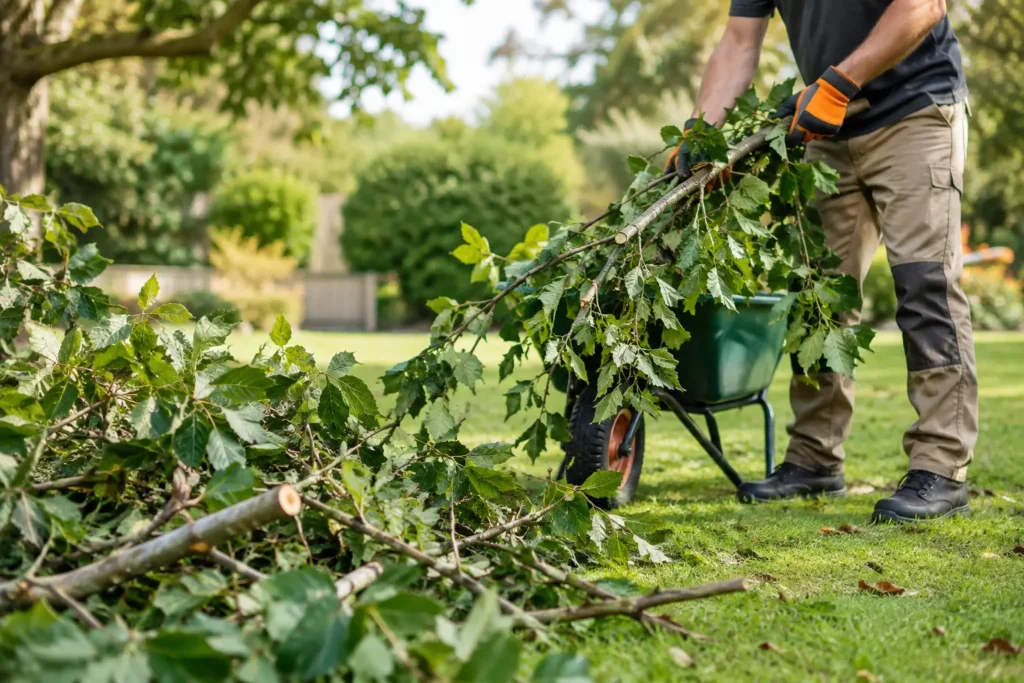
A branch across the drive is more than an inconvenience when you are trying to get the car out. After high winds, a fallen limb can block access, damage fencing, pull down gutters or leave an unstable section still hanging above the garden. Prompt, careful fallen branch clearance helps make the area safe without causing further damage to your home, boundaries or neighbouring property.
For homeowners around Newtownabbey, Glengormley and Belfast, the right response depends on where the branch has landed, its size and whether the tree is still moving or under tension. Small, clear debris may be straightforward to deal with. Heavy timber, branches near power lines, rooflines or roads, and anything partly attached to the tree should be left to trained professionals.
Make the Area Safe Before Any Clearance
The first priority is to keep people, pets and vehicles away from the affected area. A fallen branch may look settled but still be held under pressure by other branches, a fence panel or the ground beneath it. Cutting or moving it without understanding that tension can make the timber spring, roll or drop unexpectedly.
If a branch has blocked a path or driveway, use another safe route where possible. Do not climb over it, pull at it from the road side or attempt to drag it away with a car. This is especially important after a storm, when the remaining tree may have cracked limbs overhead that are not immediately obvious.
Take a quick look from a safe distance. Signs that the situation needs urgent attention include a branch resting on a roof, a damaged fence leaning into a public path, timber touching cables, a split trunk, or a large limb that remains partly suspended. In these cases, keeping the area clear is the sensible first step.
When Fallen Branch Clearance Needs a Professional
A few twigs and light garden debris are one thing. A substantial branch is another. The weight of wet timber can be surprising, and awkward access often makes a job more difficult than it first appears. Branches can also be tangled through fencing, caught in hedges or lying across sheds, greenhouses and gates.
Professional clearance is the safer choice when the branch is too large to lift comfortably, lies close to a building, has damaged a boundary, or needs cutting into manageable sections. It is also the right option where the branch has fallen from height and there may be more loose material in the canopy.
A careful contractor will assess the whole tree rather than simply remove what is on the ground. That matters because the visible fallen branch may be only part of the problem. Storms can expose dead wood, weak unions between stems, root movement or limbs that have been torn but not fully detached. Removing the obstruction while leaving a dangerous hanging branch behind does not provide a lasting solution.
At Abbey Tree and Fencing Services, the approach is to assess access, nearby structures and the condition of the remaining tree before work begins. This helps protect drives, lawns, gates, sheds and existing boundaries while ensuring the area is left tidy once the clearance is complete.
Protecting Fences, Roofs and Access Routes
Fences are often the first thing to suffer when a branch comes down. A heavy limb can crack panels, shear posts, bend rails and loosen concrete bases. Even where the damage looks limited, the impact may have weakened a section enough for the next period of wind to bring it down completely.
Before removing timber from a fence, it is worth checking how the branch is supported. A branch resting across several panels may be holding them in position. Lifting it too quickly can pull an already damaged fence sideways or snap another panel. The timber may need to be dismantled in controlled sections rather than shifted in one piece.
The same principle applies around roofs and gutters. A branch that has landed on tiles or a garage roof should not be dragged away across the surface. Controlled removal reduces the chance of dislodging tiles, tearing felt or worsening damage to guttering. If access is restricted, the safest method may involve reducing the branch where it lies before lifting it clear.
Driveways and paths need attention too. Beyond the obvious obstruction, broken branches can leave sharp stubs, slippery leaves and smaller debris underfoot. A proper clearance should leave the route usable again, not merely move the largest piece to one side of the garden.
What Happens During a Safe Clearance Visit
The work normally begins with a practical site assessment. This considers the size and position of the branch, whether it is under tension, the tree it came from, safe working space and the best route for removing waste. It also identifies anything that needs protection, such as a lawn, flower beds, fencing, parked vehicles or a narrow side passage.
Where a limb is still attached, it is reduced in a controlled order to prevent sudden movement. Grounded branches are cut into sections that can be handled safely and removed without dragging them across vulnerable surfaces. The exact method varies from property to property. A branch in an open rear garden is very different from one wedged between a garage and a fence line.
Once the main obstruction is removed, the surrounding area should be checked for secondary hazards. This may include splintered timber, damaged fence components, loose branches above, or a stump and root area affected by wind movement. If further tree work is advisable, such as crown reduction, removal of dead wood or the removal of a badly damaged tree, you should receive clear advice based on the condition of the site rather than pressure to arrange unnecessary work.
The final stage is the clean-up. Branches, brash and cut timber should be cleared away, and paths or drives swept so that the property looks improved rather than like a work site. This is particularly valuable where storm debris has spread through a garden or along a shared access route.
Should You Keep the Timber?
It depends on the type of tree, the amount of space available and what you intend to do with it. Smaller logs can be useful for a wood burner, provided they are stored and seasoned properly. Freshly cut wood is usually too wet to burn efficiently, so it needs time in a dry, ventilated store.
For many households, removal is the more practical option. Large lengths of timber take up space, attract damp around the garden if stacked badly, and can be difficult to move later. If the branch is diseased, badly split or mixed with contaminated storm debris, clearing it from the site is often preferable.
It is worth agreeing this before the work starts. Some owners want logs left neatly stacked in one corner, while others want all waste removed so the garden is immediately clear. A straightforward quotation should make that arrangement clear.
Preventing Repeat Problems After Storm Damage
No tree can be made completely storm-proof, particularly during severe weather. However, regular inspection and timely maintenance can reduce the chance of branches failing over drives, roofs, fences and gardens. Dead, damaged or overextended limbs are more likely to come down in high winds, especially where a tree has become unbalanced or overcrowded.
Watch for dead branches, fresh cracks, fungal growth around the base, lifting soil near roots, rubbing limbs and branches growing too close to buildings or boundary lines. These do not always mean a tree needs removing. In many cases, selective pruning or crown reduction can improve clearance and reduce weight while retaining the tree’s shape and value in the garden.
It is also sensible to check trees after a period of strong wind, even if no branch has fallen. A quick professional assessment can identify damage before it becomes an emergency, particularly around mature trees near homes, garages, access routes and neighbouring fences.
A fallen branch is best treated as a safety issue first and a garden tidy-up second. Keeping clear of unstable timber, arranging the right level of help and checking the remaining tree can protect the property now and prevent a smaller problem becoming the next storm’s major disruption.